
The Predictive Fitness Framework: How Analytics Forecast Performance, Consistency & Long-Term Results
May 10, 2026
Fitness Intelligence Quotient (FIQ): Measuring the Hidden Drivers of Long-Term Fitness Success
May 29, 2026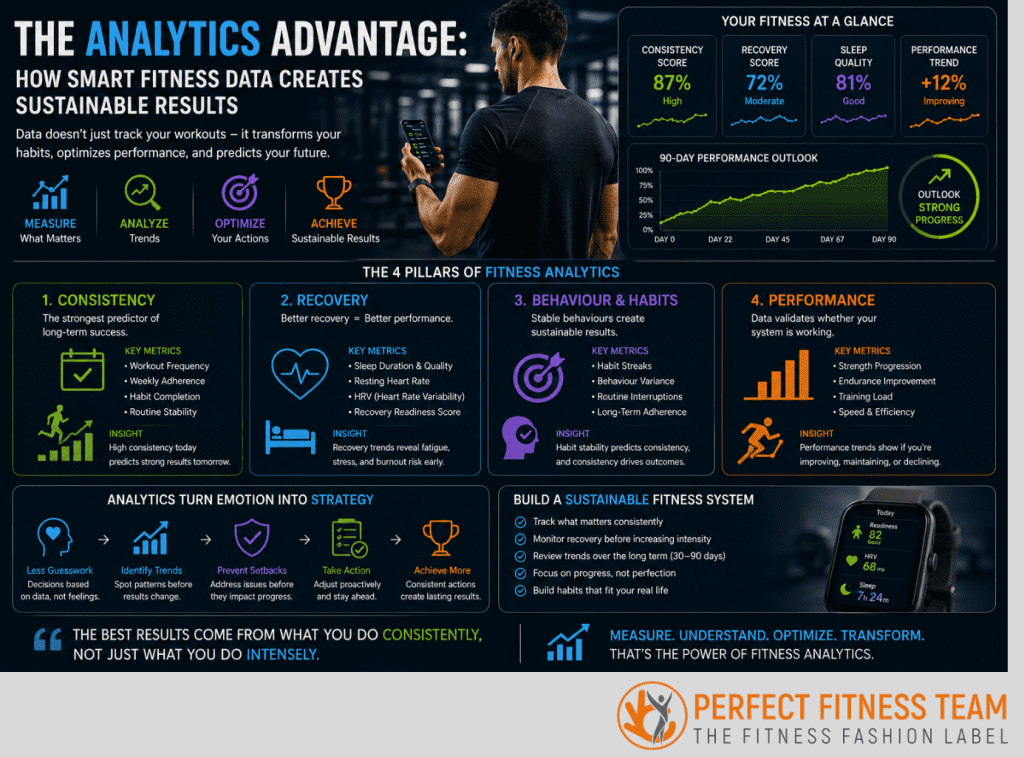
The modern fitness industry is evolving rapidly.
What once depended primarily on motivation and intuition is now increasingly guided by analytics, behavioural data, and measurable performance trends.
Today, fitness is no longer just about training hard.
It’s about training intelligently.
At Perfect Fitness Team, we believe the biggest transformation in fitness isn’t physical—it’s analytical.
Because when you understand the patterns behind performance, you gain the ability to create sustainable results instead of temporary progress.
1. Why Fitness Analytics Matter More Than Ever
Most people focus only on outcomes:
- Weight loss
- Muscle gain
- Body composition
- Visible transformation
But these are delayed indicators.
They show the result after behaviours have already repeated for weeks or months.
Fitness analytics focus instead on leading indicators:
- Consistency trends
- Recovery quality
- Sleep performance
- Behavioural patterns
- Training adherence
These metrics reveal whether your current system is moving toward progress—or regression.
2. Consistency: The Most Important Metric in Fitness
Across behavioural and performance research, one insight appears repeatedly:
Consistency predicts results more accurately than intensity.
Analytics platforms measure consistency through:
- Workout frequency
- Weekly adherence rates
- Habit completion
- Routine stability
The reason consistency matters so much is simple:
small behaviours repeated over time create compounding adaptation.
People often fail not because they lack effort, but because their effort is unstable.
Analytics make instability visible.
3. Recovery Intelligence: The Hidden Performance Multiplier
Most individuals focus heavily on workouts but underestimate recovery.
Modern analytics now track:
- Sleep quality
- Resting heart rate trends
- Recovery/readiness scores
- Heart rate variability (HRV)
These metrics provide insight into:
- Fatigue accumulation
- Stress adaptation
- Burnout risk
- Recovery efficiency
High performance is not just created by training harder.
It is created by balancing stress with recovery intelligently.
4. Behavioural Analytics and Habit Stability
Fitness is ultimately behavioural.
What determines long-term success is not occasional motivation but repeated action patterns.
Behaviour analytics reveal:
- Habit streaks
- Routine interruptions
- Adherence consistency
- Long-term behavioural stability
This creates self-awareness.
Individuals begin to identify:
- When discipline drops
- When routines become unstable
- Which habits produce the strongest outcomes
Over time, this shifts identity from:
“I’m trying to get fit”
to:
“I consistently follow systems that produce results.”
5. Data Turns Emotion into Strategy
Without analytics, most fitness decisions are emotional:
- “I feel tired.”
- “I think I’m progressing.”
- “Maybe I need a new program.”
Analytics replace emotion with evidence.
Instead of reacting impulsively, individuals can:
📊 Monitor patterns
📊 Identify trends
📊 Forecast performance drops
📊 Adjust proactively
📊 Improve consistency strategically
This creates confidence because progress becomes measurable rather than uncertain.
6. Building a Sustainable Fitness System
To use analytics effectively:
✔ Track weekly consistency, not isolated workouts
✔ Monitor recovery before increasing intensity
✔ Review behaviour trends over 30–90 days
✔ Focus on long-term patterns rather than daily fluctuations
✔ Build routines that are repeatable under real-life conditions
Sustainable fitness is not built through perfection.
It is built through repeatable systems.
Conclusion: The Future of Fitness Is Analytical
Fitness analytics are not about obsessing over numbers.
They are about:
- Understanding behaviour
- Creating clarity
- Improving decision-making
- Building predictable systems
At Perfect Fitness Team, we believe the strongest results happen when:
- effort becomes measurable,
- habits become visible, and
- progress becomes predictable.
Because long-term fitness is not random.
It is patterned, trackable, and trainable.
And analytics help reveal the pattern.