
The Analytics Advantage: How Smart Fitness Data Creates Sustainable Results
May 13, 2026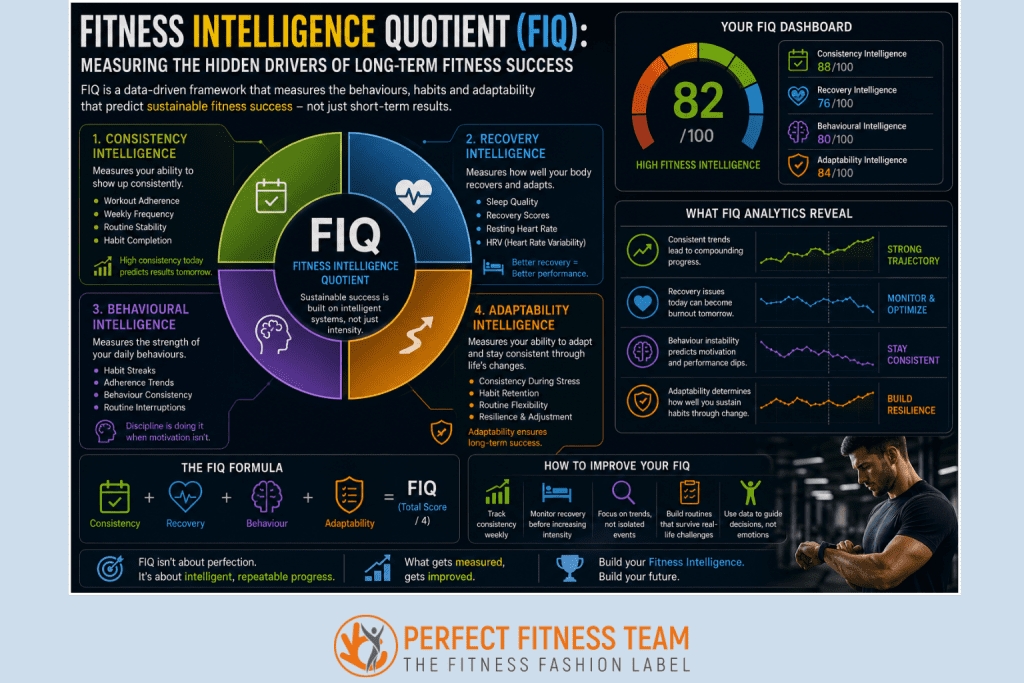
For decades, fitness has been measured using visible outcomes.
How much weight was lost?
How much muscle was gained?
How fast can you run?
How much can you lift?
While these indicators matter, they often fail to explain why some individuals sustain results for years while others struggle to maintain progress despite equal effort.
The answer lies in what we call the Fitness Intelligence Quotient (FIQ)—a data-driven framework that evaluates the hidden factors responsible for long-term fitness success.
At Perfect Fitness Team, we believe that sustainable fitness is not merely a function of physical capability. It is the result of consistency, recovery, behavioural discipline, adaptability, and intelligent decision-making.
These are measurable.
And analytics allows us to measure them.
What is Fitness Intelligence Quotient?
Fitness Intelligence Quotient (FIQ) is a conceptual score that evaluates an individual’s ability to create, sustain, and optimize fitness behaviours over time.
Unlike traditional fitness metrics that focus on outcomes, FIQ focuses on the systems that create those outcomes.
The framework evaluates four core dimensions:
1. Consistency Intelligence
Consistency remains the strongest predictor of long-term fitness success.
Analytics measure:
- Workout adherence
- Weekly training frequency
- Routine stability
- Habit completion rates
A high consistency score indicates that an individual can maintain positive behaviours regardless of motivation fluctuations.
This is often more valuable than short bursts of high performance.
2. Recovery Intelligence
Recovery determines whether effort translates into adaptation.
Modern analytics allow individuals to monitor:
- Sleep quality
- Recovery scores
- Resting heart rate trends
- Heart Rate Variability (HRV)
Individuals with strong recovery intelligence understand when to push and when to recover.
This reduces burnout and improves long-term performance sustainability.
3. Behavioural Intelligence
Fitness is ultimately behavioural.
Analytics can reveal:
- Habit streaks
- Adherence trends
- Behaviour interruptions
- Routine consistency
Behavioural intelligence reflects an individual’s ability to execute fitness behaviours repeatedly over time.
This is where discipline becomes measurable.
4. Adaptability Intelligence
Life changes.
Schedules change.
Workloads change.
Stress levels change.
The most successful individuals are not those who follow perfect routines.
They are those who adapt without abandoning their systems.
Adaptability analytics track:
- Recovery during stressful periods
- Habit retention during disruptions
- Consistency under changing conditions
This is one of the strongest predictors of long-term success.
Why Fitness Intelligence Matters
Many people focus exclusively on performance outputs.
However, outputs are delayed indicators.
Analytics show that behaviours precede outcomes.
For example:
- Consistency declines before performance declines.
- Poor recovery appears before burnout.
- Habit instability appears before motivation drops.
- Sleep disruption often precedes reduced performance.
Understanding these patterns allows proactive intervention.
Instead of reacting to setbacks, individuals can prevent them.
The FIQ Formula
A simplified Fitness Intelligence Quotient model can be expressed as:
FIQ = (Consistency + Recovery + Behaviour + Adaptability) ÷ 4
While the exact scoring system may vary, the principle remains the same:
Higher FIQ scores indicate a greater probability of achieving and sustaining long-term fitness success.
How to Improve Your Fitness Intelligence Quotient
To improve FIQ:
✔ Track consistency weekly
✔ Monitor recovery alongside performance
✔ Focus on behavioural trends over isolated events
✔ Build routines that survive real-life challenges
✔ Use data to guide decisions rather than emotions
The goal is not perfection.
The goal is intelligent, repeatable progress.
Conclusion
The future of fitness is not simply stronger bodies.
It is smarter systems.
At Perfect Fitness Team, we believe the next generation of fitness success will be driven by individuals who understand their data, measure their behaviours, and continuously optimize their habits.
Because sustainable fitness is not about intensity alone.
It is about intelligence.
And analytics gives us the ability to measure it.