
The Consistency Index: How Fitness Analytics Predict Your Next 90 Days
May 1, 2026
The Analytics Advantage: How Smart Fitness Data Creates Sustainable Results
May 13, 2026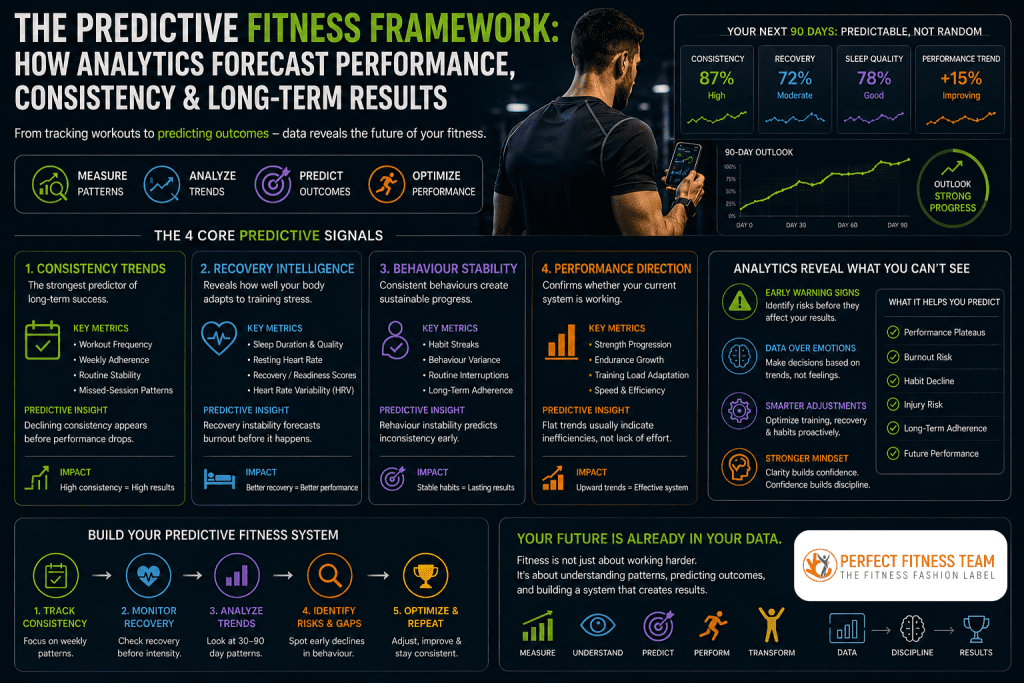
The future of fitness is no longer based on guesswork.
It is based on prediction.
Today’s fitness analytics do more than measure workouts — they identify patterns, forecast outcomes, and reveal behavioural trends that determine whether progress is sustainable or temporary.
At Perfect Fitness Team, we believe the next evolution of fitness is not simply training harder. It is understanding the data behind performance and using that insight to make smarter, more strategic decisions.
This is what we call the Predictive Fitness Framework.
1. From Tracking to Forecasting
Traditional fitness tracking answers one question:
“What happened?”
Predictive fitness analytics answer a more powerful question:
“What is likely to happen next?”
By analysing:
- Consistency trends
- Recovery signals
- Sleep quality
- Behaviour stability
- Training load patterns
analytics can forecast:
- Performance plateaus
- Burnout risk
- Habit decline
- Long-term adherence
- Future performance potential
This transforms fitness from reactive effort into proactive optimization.
2. The Four Core Predictive Signals
🔹 1. Consistency Trends
Consistency remains the strongest predictor of long-term success.
Analytics track:
- Workout frequency
- Weekly adherence
- Routine stability
- Missed-session patterns
Research and behavioural data consistently show that stable training patterns outperform short bursts of intensity.
👉 Predictive insight:
Declining consistency trends often appear before visible performance drops.
🔹 2. Recovery Intelligence
Recovery analytics reveal whether the body is adapting positively to stress.
Key metrics include:
- Sleep duration and quality
- Resting heart rate trends
- Recovery/readiness scores
- Heart rate variability (HRV)
When recovery declines:
- Motivation drops
- Performance weakens
- Injury risk rises
👉 Predictive insight:
Recovery instability often forecasts burnout before it happens.
🔹 3. Behaviour Stability
Fitness is behaviour repeated over time.
Analytics identify:
- Habit streaks
- Behaviour variance
- Routine interruptions
- Long-term adherence patterns
Stable behaviour patterns create sustainable progress curves.
👉 Predictive insight:
Behaviour instability predicts inconsistency long before results plateau.
🔹 4. Performance Direction
Performance metrics track output trends such as:
- Strength progression
- Endurance growth
- Training load adaptation
- Speed and recovery efficiency
These metrics validate whether your current system is producing meaningful adaptation.
👉 Predictive insight:
Flat performance trends usually indicate system inefficiencies rather than lack of effort.
3. Why Most People Misread Fitness Progress
One of the biggest mistakes in fitness is overreacting to short-term outcomes.
Examples:
- One bad workout → panic
- One missed day → guilt
- One plateau → program hopping
Analytics help eliminate emotional decision-making by focusing on:
- Trends over time
- Pattern consistency
- Long-term signals
This creates clarity — and clarity improves discipline.
4. The Psychology Behind Predictive Fitness
When individuals understand their behavioural patterns:
- Confidence increases
- Anxiety decreases
- Motivation becomes more stable
- Discipline becomes system-driven
This is because analytics replace uncertainty with measurable evidence.
People stop asking:
“Am I progressing?”
And start asking:
“What patterns are shaping my progress?”
That mindset shift is transformational.
5. Building Your Own Predictive Fitness System
To implement predictive analytics effectively:
📊 Track consistency weekly, not emotionally
📊 Review recovery metrics before increasing intensity
📊 Monitor behaviour patterns over 30–90 days
📊 Focus on trends rather than isolated sessions
📊 Build routines that are repeatable under real-life conditions
The goal is not perfection.
The goal is predictability.
Conclusion: Fitness Is More Predictable Than You Think
Fitness success is rarely random.
Your current habits already contain signals about your future performance:
- Consistency predicts adherence
- Recovery predicts resilience
- Behaviour predicts sustainability
- Trends predict results
At Perfect Fitness Team, we believe analytics allow individuals to stop reacting to fitness and start understanding it.
Because the strongest transformations happen when:
- effort becomes measurable,
- behaviour becomes visible, and
- progress becomes predictable.
The future of fitness is not just physical.
It is analytical.