
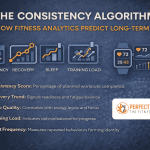
The Consistency Algorithm: How Fitness Analytics Predict Long-Term Results
February 18, 2026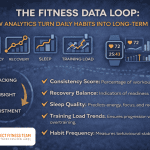
The Fitness Data Loop: How Analytics Turn Daily Habits into Long-Term Results
March 6, 2026
Motivation starts fitness journeys.
Analytics sustain them.
For years, progress in fitness relied on emotion — how hard a workout felt, how motivated someone was, or what the mirror reflected. Today, performance is no longer subjective. It is measurable.
At Perfect Fitness Team, we approach fitness through a behavioural lens:
If it can be measured, it can be improved.
1️⃣ The Shift from Emotion to Evidence
Modern fitness platforms collect vast amounts of data — not just steps and calories, but behavioural indicators such as:
- Workout frequency
- Session completion rates
- Recovery balance
- Sleep efficiency
- Training load variation
- Habit repetition
When these metrics are analysed together, they reveal patterns that predict success more accurately than motivation alone.
Data replaces emotional fluctuation with structural consistency.
2️⃣ The Analytics Hierarchy of Fitness Success
Not all metrics matter equally. Some predict long-term adherence better than others.
🔹 Tier 1: Consistency Index
The number of sessions completed relative to sessions planned.
This single metric correlates strongest with sustainable transformation.
Why? Because intensity without repetition fails.
Consistency builds physiological and psychological adaptation.
🔹 Tier 2: Recovery & Adaptation Metrics
Recovery scores, resting heart rate trends, and HRV patterns signal readiness.
Analytics show that when individuals adjust training intensity based on recovery feedback, they reduce injury risk and improve long-term performance stability.
Recovery management is resilience management.
🔹 Tier 3: Sleep & Behavioural Stability
Sleep analytics often predict workout quality before the workout happens.
Poor sleep correlates with:
- Lower motivation
- Reduced focus
- Decreased performance output
Monitoring sleep patterns allows pre-emptive adjustment — a strategic advantage.
🔹 Tier 4: Habit Frequency
Habits are micro-decisions repeated daily.
Analytics expose whether behaviour is stable or erratic.
When habit completion becomes measurable, identity shifts from:
“I hope I stay consistent”
to
“I consistently follow through.”
3️⃣ Predictability: The Real Goal
The strongest fitness programs are not those that produce extreme short-term results.
They are those that produce predictable long-term patterns.
Analytics provide:
- Trend lines instead of emotional swings
- Feedback loops instead of assumptions
- Adaptation insights instead of guesswork
When progress becomes predictable, discipline becomes easier.
4️⃣ Mental Strength Through Structured Feedback
Mental strength is often seen as intangible.
Analytics make it tangible.
Tracking data:
- Reduces uncertainty
- Strengthens self-trust
- Encourages reflection
- Builds accountability
Each completed session recorded in data reinforces identity.
Each visible streak strengthens confidence.
Analytics transform discipline from willpower into structure.
5️⃣ Practical Implementation Strategy
To use analytics effectively:
✔ Track training frequency weekly
✔ Monitor recovery before increasing intensity
✔ Review sleep patterns alongside performance
✔ Adjust load based on data, not emotion
✔ Focus on behavioural trends, not single days
Fitness is not built on isolated effort.
It is built on patterns.
Conclusion: Data Creates Discipline
Fitness analytics are not about obsessing over numbers.
They are about reducing uncertainty.
When behaviour is tracked, patterns become visible.
When patterns are visible, improvements become strategic.
When improvements are strategic, progress becomes sustainable.
At Perfect Fitness Team, we believe that data-driven fitness is not a trend — it is the future of long-term resilience, mental strength, and physical transformation.
Motivation begins the journey.
Analytics finish it.