
The Fitness Dashboard: How Data Turns Daily Actions into Measurable Progress
April 18, 2026
The Consistency Index: How Fitness Analytics Predict Your Next 90 Days
May 1, 2026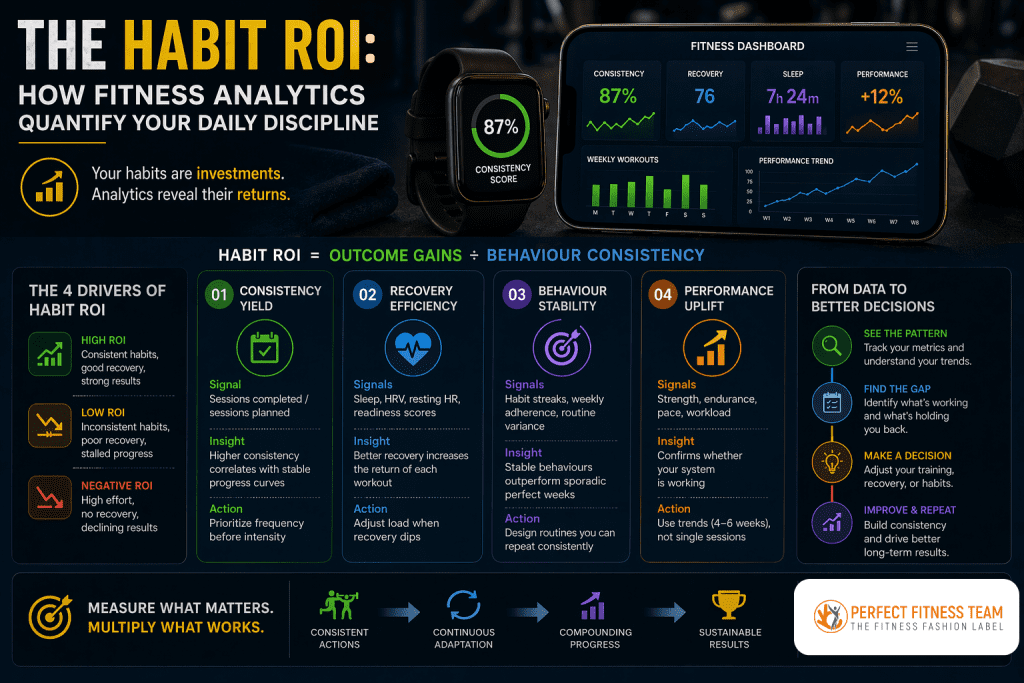
We often talk about “putting in the work” in fitness.
But what if you could measure the return on that work?
In business, ROI (Return on Investment) tells you whether your effort is paying off. In fitness, analytics play the same role—they show how your daily habits translate into outcomes over time.
At Perfect Fitness Team, we frame progress through a simple idea:
Your habits are investments. Analytics reveal their returns.
1) From Effort to Return: Why ROI Thinking Matters
Most people evaluate fitness based on outcomes:
- Weight changes
- Body composition
- Visible transformation
These are lagging indicators. They tell you what has already happened.
Analytics shift the focus to leading indicators—the behaviours that create results:
- How often you train
- How well you recover
- How consistently you sleep
- How stable your routines are
ROI thinking asks:
Which behaviours are producing the highest return over time?
2) Defining “Habit ROI” in Fitness
Habit ROI = (Outcome Gains) ÷ (Behaviour Consistency)
In practical terms:
- If your consistency rises and outcomes improve → positive ROI
- If effort is high but results stagnate → inefficient ROI
- If recovery is poor and performance drops → negative ROI
Analytics help quantify this by connecting behaviour → adaptation → outcome.
3) The Four Drivers of Habit ROI
🔹 Consistency Yield
Measures how reliably you execute your plan.
Signal: Sessions completed / sessions planned
Insight: Higher consistency correlates with stable progress curves
Action: Prioritize frequency before intensity
🔹 Recovery Efficiency
Tracks how well your body converts stress into adaptation.
Signals: Sleep duration/quality, resting HR trends, readiness scores
Insight: Better recovery increases the “return” of each workout
Action: Adjust load when recovery dips
🔹 Behaviour Stability
Evaluates how repeatable your routines are.
Signals: Habit streaks, weekly adherence, variance in routines
Insight: Stable behaviours outperform sporadic “perfect weeks”
Action: Design routines you can repeat under real-life constraints
🔹 Performance Uplift
Measures output trends over time.
Signals: Strength progression, endurance capacity, pace improvements
Insight: Confirms whether your system is working
Action: Use trends (4–6 weeks), not single sessions, to judge progress
4) Where ROI Gets Lost (Common Failure Patterns)
Analytics frequently reveal why effort doesn’t translate into results:
- High intensity, low consistency → burnout cycles
- Good training, poor recovery → plateau or regression
- Inconsistent habits → no compounding effect
- Overreacting to daily data → chaotic decision-making
ROI drops when behaviour lacks structure.
5) Building a High-ROI Fitness System
To improve your Habit ROI:
📊 Track weekly consistency (not just workouts)
📊 Pair performance with recovery data
📊 Stabilize 2–3 core habits before adding complexity
📊 Review trends every 7–14 days
📊 Optimize the system, not individual sessions
Think like an investor:
- You don’t need perfect days
- You need repeatable, compounding habits
6) The Mental Shift: From Motivation to Metrics
When you measure ROI, your mindset changes:
- From “Did I feel motivated?” → “Did I execute consistently?”
- From “Was today perfect?” → “Are my trends improving?”
- From “Am I progressing?” → “What’s driving my progress?”
Analytics reduce emotional noise and replace it with clear feedback loops.
That clarity builds discipline—and discipline compounds.
Conclusion: Measure What Matters, Multiply What Works
Fitness is not just about doing more.
It’s about doing what works—and doing it consistently.
Analytics help you:
- Identify high-return behaviours
- Eliminate low-return patterns
- Build a system that compounds over time
At Perfect Fitness Team, we focus on one outcome:
Turning daily discipline into measurable returns.
Because in fitness—like in business—
what gets measured, scales.